
In order to improve the quality of automotive painting and the utilization rate of coatings, and reduce the harm of coatings to people during the automotive painting process, spraying robots are widely used for automotive painting, and the painting production line has basically achieved unmanned automatic spraying. With the diversification of people's demand for automotive products, the mixing degree of multi vehicle and multi color spraying on a single production line continues to increase. Within a certain production cycle, it is necessary to minimize the time for robot color changing and cleaning as much as possible. In order to ensure the quality of spraying, the requirements for robot color changing and cleaning are also increasing.
1.Color changing system and principle of spraying robot
Spraying robot changes color block structure
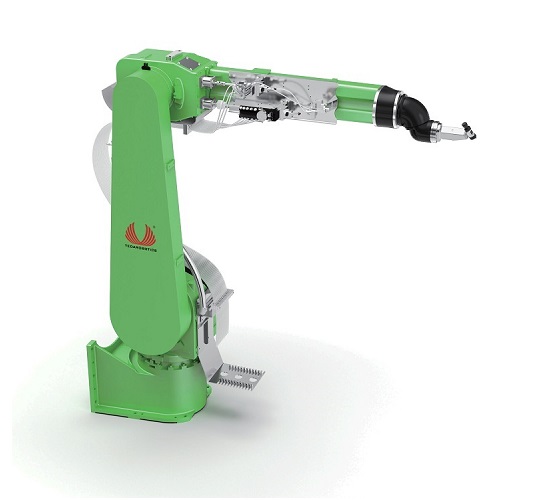
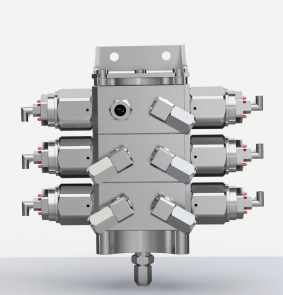
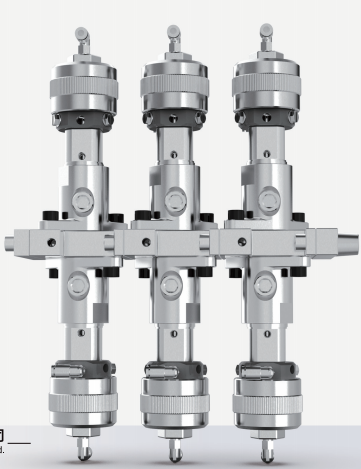
The color change of the spraying robot is achieved through acolor change valve group, which is installed in the robot's arm, relatively close to the atomizer of the robot. The color changing valve group is integrated by color changing blocks, and each color changing block can convert 2 colors. The number of color changing blocks can be increased or decreased according to on-site needs. The paint for each color is connected to the color changing block through a separate paint supply pipeline.
Color changing principle of spraying robot
When spraying a certain color, the electromagnetic valve that controls the compressed air receives a signal. At this time, the two three-way valves in the air control cabinet open, releasing compressed air into the air. The micro valve opens under the action of compressed air, and the paint of this color flows into the channel, then enters the gear pump through the stabilizer. Under the action of high voltage static electricity and shaping air, the paint is atomized and attached to the surface of the vehicle body through the centrifugal force of the rotary cup. If this color is not sprayed, the micro valve will not open, and the paint will flow into the circulation pipeline through another interface for circulation after entering. After each spraying is completed, the channel needs to be purged with solvent and compressed air.
Factors affecting the color change effect
In the actual production process, there are many factors that affect the color change process, including color change step time, solvent temperature, compressed air pressure, paint type, and hardware facility status.
a. Change color step time
The time of the color changing step affects the cleaning effect of the pipeline. While ensuring the production cycle, it is necessary to increase the time of the color changing step as much as possible to fully clean the residual materials in the pipeline and blow it clean to avoid alarm faults such as overcurrent. Shortening the spraying time of a single robot can optimize the robot imitation, such as increasing the robot gun speed and reducing the waiting time during the robot spraying process; Improving the filling speed of robots can provide optimized space for cleaning.
b. Cleaning solvent, compressed air
There is a certain difference in the cleaning effect of solvents under different temperature conditions. On site solvent temperature control is achieved through dual control of the temperature control system and robot heater. However, due to seasonal temperature changes, there is heat loss in the solvent from heating to use, which affects the cleaning effect. The higher the solvent temperature, the stronger the cleaning ability.
Cleaning solvents are prepared by mixing solvents and pure water in a certain ratio. Different ratios have different cleaning effects on materials, and the higher the ratio of solvents to pure water, the stronger the cleaning ability.
Compressed air pressure is mainly used to blow dry residual solvents and paint, ensure the cleanliness of the discharge pipeline, and avoid the formation of a circuit that may cause current limiting. When the current is too high, high voltage or overcurrent faults may occur. Therefore, ensuring sufficient pressure is important for the blowing effect.
c. Different attribute paints
Paint mainly contains resin, additives, and fillers. The composition and proportion of different paint fillers vary, and solvents have different cleaning abilities. After on-site comparison and data analysis, it was found that there are differences in the cleaning effect of different paints under the same conditions. Paint contains pigments, and light colored paint has better cleaning effect than dark colored paint, while natural colored paint has better cleaning effect than metallic paint; Therefore, the solvent on site must meet the requirements for cleaning the most difficult paint.
d. Hardware device status
All instructions need to be completed through hardware, and the state of the hardware plays an important role in the execution effect; The main hardware includes air solvent module, valves EX600。
The air solvent module allows solvent and compressed air to pass through simultaneously, and its internal valves can alternate between passing solvent and compressed air to form a mixture, ensuring that the pipeline and rotary cup can be cleaned thoroughly. When the module ruptures or is damaged, solvent and air leaks, making it difficult to effectively clean and manage. The valve is driven to open by compressed air, and when there is no compressed air, it is closed by the action of a spring. Prolonged use of the valve can cause the spring to age and deform, and the valve core to wear out, making it impossible to close the valve or completely close the valve, resulting in leakage of the previous paint and mixing with the next paint, leading to paint contamination and discoloration. EX600 is the control center located in the robot process control cabinet, which issues execution commands and controls the opening and closing of valves through compressed air controlled by solenoid valves; When the solenoid valve plate is damaged, there will be a leakage phenomenon, so that the air cannot drive the corresponding valve, resulting in the inability to achieve the corresponding color change execution process.
CCV-LP
CCV-HP
2.Reasons for color mixing in robot spraying
Mixing colors during robot spraying
Color mixing refers to the situation where the robot sprays paint containing other colors while spraying the current color, resulting in color differences in the spraying area. When spraying pearl white color on the front cover of the vehicle, red paint is mixed in. The reasons for color mixing can be divided into two categories: one is problems with cleaning program settings, and the other is equipment failure.
2.1.1 Color mixing issues caused by cleaning program settings
a. Color mixing caused by prolonged cleaning procedures
Set the robot programmatically: during color change, the robot performs cyclic pipeline cleaning and rotary cup cleaning; Before spraying the next car body, perform pipeline filling and cup filling, which is commonly known as long cleaning. If the cleaning and color changing program sets the robot to not clean or fill the pipeline for enough time during color changing, the paint from the previous vehicle body will remain in the pipeline. When filling the next vehicle body color, all the waste paint in the pipeline cannot be discharged, and color mixing will occur during spraying. By adjusting the cleaning time of the circulation pipeline, the flow rate of cleaning solvent, and the blowing time of compressed air, increasing the cleaning and blowing time within the production cycle can effectively alleviate color mixing.
b. Color mixing caused by short cleaning programs
If spraying the same color, do not change the color, only clean the rotary cup, and do not clean the pipeline; When spraying the next car body, only the rotary cup is filled without filling the pipeline, which is called short cleaning. If the rotary cup is not cleaned thoroughly, the internal channels or the outside of the rotary cup will leave paint in the color of the car body. When spraying the next car body, it is easy to spray the remaining paint on the rotary cup onto the next car body, causing color mixing.
2.1.2 Color mixing caused by equipment failure
Due to damage to micro valves or one-way valves related to color changing and cleaning, the robot's color changing and cleaning procedures cannot be executed properly, resulting in color mixing. If the microvalve of a certain color on the color block cannot be closed normally, the paint will continuously flow out under pressure, which is equivalent to being normally open. The paint of that color will continuously mix into the currently sprayed body, causing color mixing. If there is a delay or loose closure of the microvalve switch during the cleaning process, the cleaning process cannot proceed normally, and it is easy for residual paint from the previous vehicle body to remain in the pipeline. If the color of the next vehicle body is different from that of the previous one, when spraying the next vehicle body, the robot will carry the residual paint from the pipeline during the first shot, causing color mixing at the spraying position of the next vehicle body.
Replacing the microvalve of the spraying robot can avoid color mixing, but microvalves are expensive and greatly increase equipment maintenance costs. To solve the problem of pipeline residue and ensure the quality of spraying, we can set the pre spraying trajectory and parameters for the robot in advance. When spraying the first shot, the robot can spray on the outside of the vehicle, discharge the residual paint and cleaning solvent in the pipeline, and then start spraying on the vehicle body. This can avoid color mixing, reduce the frequency of robot micro valve replacement, and lower equipment maintenance costs.